
Share
When resistors 1 and 2 are connected in series, the equivalent resistance is 20.4 Ω. When they are connected in parallel, the equivalent res
Question
When resistors 1 and 2 are connected in series, the equivalent resistance is 20.4 Ω. When they are connected in parallel, the equivalent resistance is 3.86 Ω. What are (a) the smaller resistance and (b) the larger resistance of these two resistors?
in progress
0
Physics
5 years
2021-08-04T14:11:17+00:00
2021-08-04T14:11:17+00:00 1 Answers
174 views
0

Answers ( )
Answer:
(A) Smaller resistance will be equal to 5.175 ohm
(b) Larger resistance will be equal to 15.225 ohm
Explanation:
Let the two resistances are and

It is given that when they are connected in series their equivalent resistance is 20.4 ohm
So ——eqn 1
When they are connected in parallel their equivalent resistance is 3.86 ohm
So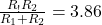
From equation 1
Adding eqn 1 and eqn 2
(a) Smaller resistance will be equal to 5.175 ohm
(b) Larger resistance will be equal to 15.225 ohm