
Share
Astronomers have observed a small, massive object at the center of our Milky Way galaxy. A ring of material orbits this massive object; the
Question
Astronomers have observed a small, massive object at the center of our Milky Way galaxy. A ring of material orbits this massive object; the ring has a diameter of about 15 light years and an orbital speed of about 200 km/s.
Observations of stars, as well as theories of the structure of stars, suggest that it is impossible for a single star to have a mass of more than about 50 solar masses. Can this massive object be a single, ordinary star?
in progress
0
Physics
4 years
2021-08-14T18:27:14+00:00
2021-08-14T18:27:14+00:00 1 Answers
134 views
0

Answers ( )
Answer: Yes, it can be a single, ordinary star.
Explanation: To determine a mass of a star, we use the orbital speed formula, given by: v = , where
v is the speed;
G is a constant: G = 6.67* [tex]\frac{m^{3} }{kg.s^{2} }[/tex]
M is mass of a massive object;
R is the distance between the object orbiting and the massive object;
The formula can be rewritten as:
First, we change R from light years to km:
1km=1.057*
R=
Calculating mass:
M =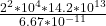
M = 4.25* kg
kg
A solar mass is the standard unit of mass. It is approximately 2* Kg and can be used for comparison: A single star cannot be more than 50 solar masses.
50 solar masses = 50*2* =
=  kg
kg
Comparing the mass of the object with this parameter, we have
From this, we know that 50 solar masses is greater than the small, massive object found. So, this object can be a single, ordinary star.