
Share
The cost of 5 gallons of ice cream has a variance of 64 with a mean of 34 dollars during the summer. What is the probability that the sampl
Question
The cost of 5 gallons of ice cream has a variance of 64 with a mean of 34 dollars during the summer. What is the probability that the sample mean would differ from the true mean by less than 1.1 dollars if a sample of 38 5-gallon pails is randomly selected
in progress
0
Mathematics
4 years
2021-08-11T18:31:17+00:00
2021-08-11T18:31:17+00:00 1 Answers
71 views
0

Answers ( )
Answer:
0.5587 = 55.87% probability that the sample mean would differ from the true mean by less than 1.1 dollars.
Step-by-step explanation:
To solve this question, we need to understand the normal probability distribution and the central limit theorem.
Normal Probability Distribution:
Problems of normal distributions can be solved using the z-score formula.
In a set with mean and standard deviation
  , the z-score of a measure X is given by:
The Z-score measures how many standard deviations the measure is from the mean. After finding the Z-score, we look at the z-score table and find the p-value associated with this z-score. This p-value is the probability that the value of the measure is smaller than X, that is, the percentile of X. Subtracting 1 by the p-value, we get the probability that the value of the measure is greater than X.
Central Limit Theorem
The Central Limit Theorem establishes that, for a normally distributed random variable X, with mean and standard deviation
  , the sampling distribution of the sample means with size n can be approximated to a normal distribution with mean
  and standard deviation
  .
.
For a skewed variable, the Central Limit Theorem can also be applied, as long as n is at least 30.
The cost of 5 gallons of ice cream has a variance of 64 with a mean of 34 dollars during the summer.
This means that
Sample of 38
This means that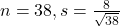
What is the probability that the sample mean would differ from the true mean by less than 1.1 dollars ?
P-value of Z when X = 34 + 1.1 = 35.1 subtracted by the p-value of Z when X = 34 – 1.1 = 32.9. So
X = 35.1
By the Central Limit Theorem
X = 32.9
0.77935 – 0.22065 = 0.5587
0.5587 = 55.87% probability that the sample mean would differ from the true mean by less than 1.1 dollars.